NeurIPS 2026
CORAL: Consolidating Reasoning with Test-Time Training
EPFL, Switzerland · *Equal contribution
Abstract
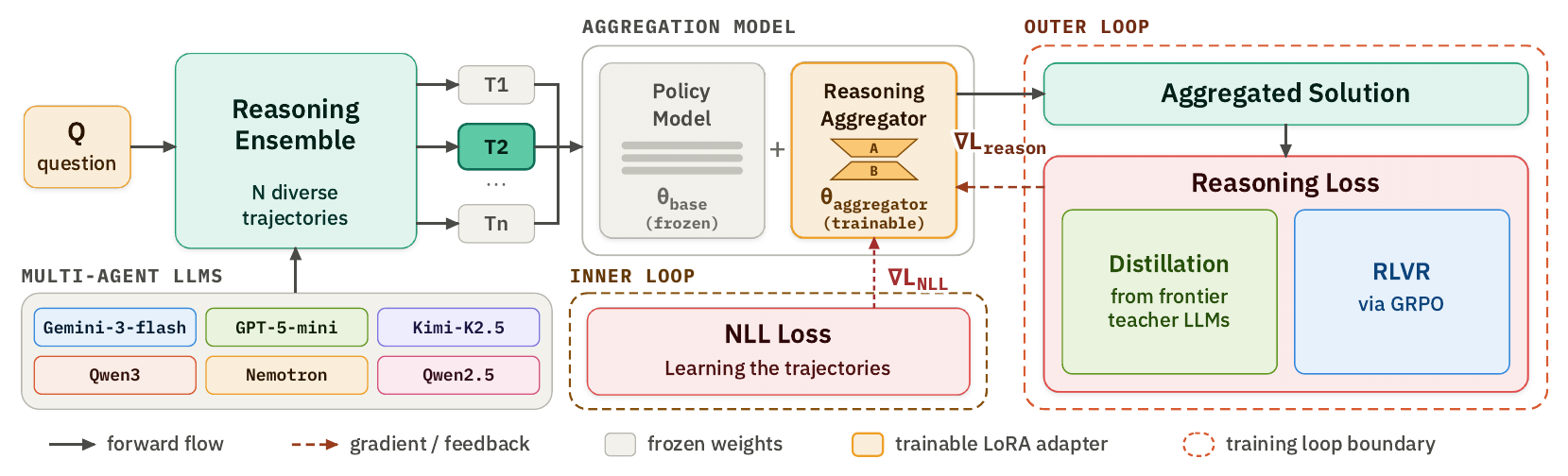
Parallel thinking scales inference-time compute by generating multiple reasoning traces for a query and aggregating them to reach a final answer. However, most aggregation algorithms treat each reasoning trajectory independently, ignoring the complementary reasoning sub-processes across the full ensemble of trajectories. To learn from these parallel trajectories, we propose CORAL (Consolidating Reasoning with Test-Time Training), a novel framework for aggregating trajectories by jointly consolidating them into parametric memory using test-time training. Our algorithm meta-learns how to consolidate using nested optimization at training time, where an inner loop encodes reasoning trajectories into a lightweight LoRA adapter, and an outer loop learns meta-parameters for the inner loop such that the consolidation is helpful for the model to synthesize a final solution.
As no standard datasets exist for training aggregation methods, we construct a novel OpenParallelThinking corpus composed of 12,810 math problems paired with a mixture of diverse trajectories from six LLMs. Evaluated on challenging mathematics and STEM benchmarks, CORAL consistently outperforms the best aggregation baselines by 20% overall. Importantly, we curate reasoning trajectories at multiple quality levels to simulate the reality of noisy parallel reasoning and demonstrate that CORAL is especially robust to the quality of thinking trajectories and able to learn useful knowledge from entirely wrong solutions. Additionally, CORAL can recover from unsuccessful trajectories and arrive at an improved solution through consolidation as test-time learning, an ability that scales with the number of incorrect trajectories available, while RL further improves the adapted policy's ability to reason over the consolidated trajectories. We will release CORAL and OpenParallelThinking for use in future work on reasoning aggregation.
BibTeX
@inproceedings{wu2026coral,
  title     = {Consolidating Reasoning with Test-Time Training},
  author    = {Wu, Haotian and Chen, Zeming and Zhao, Hao and Bosselut, Antoine},
  booktitle = {Advances in Neural Information Processing Systems},
  year      = {2026}
}